Category: Uncategorized

  • The Trip of a Lifetime

    The Trip of a Lifetime

    Four on A Tour in England

    by Robert & Elizabeth Shackleton

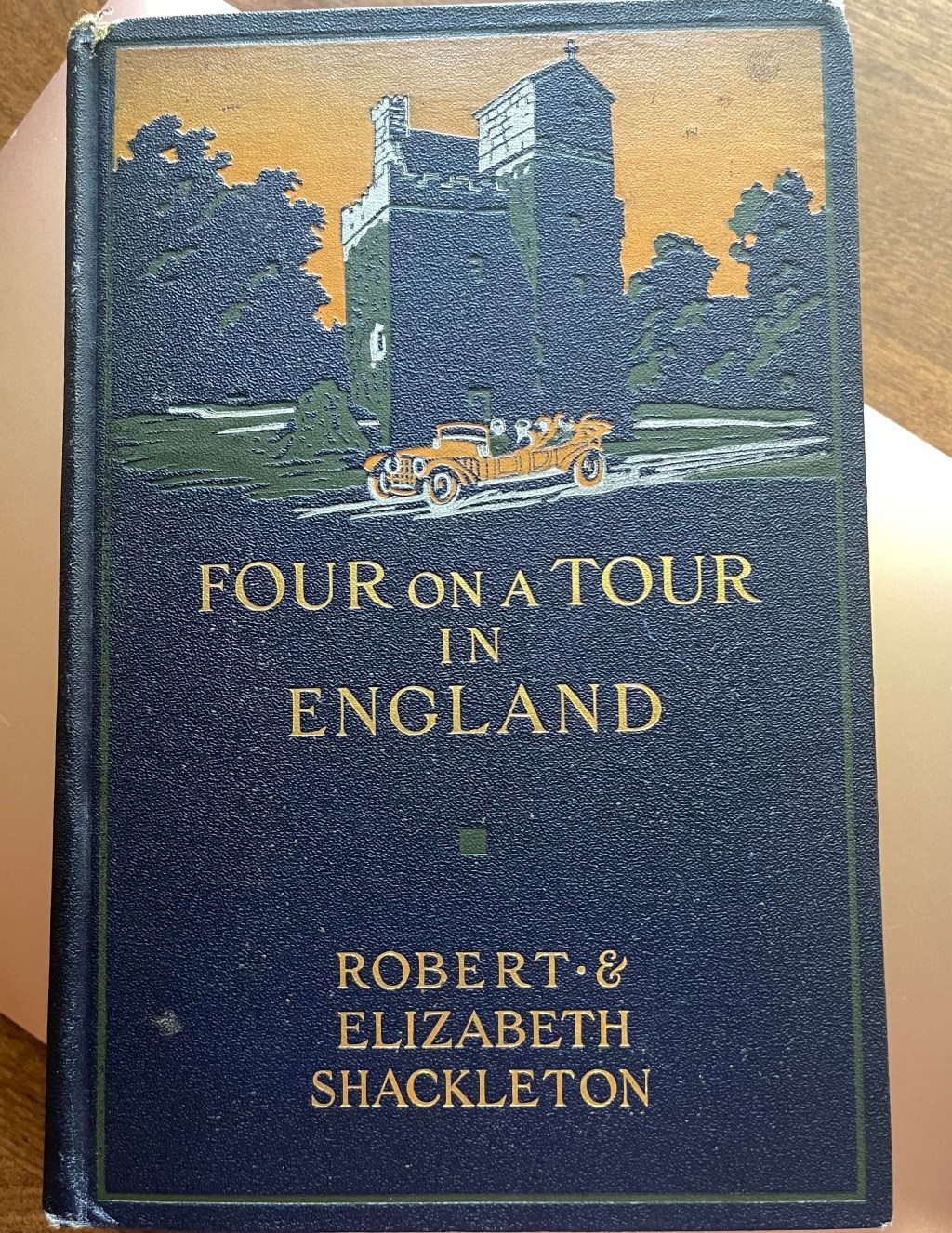
    The moment I saw it, I had to have it. The deep green cover and the shimmering gold leaf image and lettering that is barely dimmed by the passage of time immediately caught my eye. Written and published in 1914 (a time period that fascinates me), this book’s cover image of a touring car has captured, in my imagination, our fortunate four American friends in mid journey. The brass headlamps shining as it motors along on an English country road. In the background is a turreted castle nestled among tall trees. It is a moment frozen in time. The details are rendered with precision, from the folds in the travelers’ coats to the branches of the trees. This isn’t just a book – it’s a work of art about a long ago road trip through the heart of Great Britain.

    Opening this book is stepping into history. What makes it even more precious to me is the simple handwritten inscription on the flyleaf: “D.H. Ball from Millie Conklin, Dec 25-1915”. Just over a year after its publication, this book was wrapped and put under a Christmas tree. What a splendid gift! I wonder, did the recipient of this beautiful book look forward to his own journey in England, or was he content to let the Shackletons carry him away with the written word?

    The frontispiece is a very well preserved beautifully illustrated map of the British Isles in faded tones of blue, green and red. In small print are the names of towns and villages that conjure up ancient stones, misty moors, and quaint inns: Lands End, Bath, Tunbridge Wells. I trace the routes with my finger, close my eyes, and imagine myself to be sitting in the back seat bouncing along the early 20th century roads with four friends. No GPS, no clogged highways, no hurry to make it to the next stop. A journey that is about observing and learning.

    Before August 4, 1914

    It’s impossible for me to read this book without feeling the heaviness of what was to come. I want to take our travelers aside and tell them to enjoy every precious moment for their world will soon change. In the early summer of 1914 the England in these pages comes across as unspoiled and quiet. The country seems to be suspended in a golden haze blissfully unaware that the “Great War” will soon be knocking at its door. The young men who are now working in the fields, but taking time to wave at the passing touring car, will soon be in the battlefield trenches waving their rifles and longing to be home. But all of that is yet to come. This motor journey is about enjoying the peaceful British countryside. A countryside where automobiles are still a novelty and the dirt roads are decent but not the best. Scattered throughout the book are black and white photographs that are like postcards to home. It is like sharing a cherished family photo album; I love each and every photo. It is a scrapbook of a vanished world. Stone bridges over calm rivers, twisted lanes dotted with thatched roof cottages, towering cathedral spires, crumbling ruins. These photos were taken deliberately and with care, capturing moments that became cherished memories. To ride in that automobile in the early summer days of 1914 would be a dream. No radio, no GPS, no traffic jams. My mother’s family would still be living in Sussex so I would definitely have to make a side trip. What a joy to do it with these four travelers and listen to their friendly chatter while anticipating the promise of the next village around the bend.

    There is not enough room here to mention all of the sites that the Shackletons and their friends visited. I daresay that the majority remain today. I will be going back to England this Autumn and intend on following up a few of their favorites. The Shackletons’ writing style is easy and friendly; I have no idea if it is a true collaboration between husband and wife or if Elizabeth was content to let him take the lead. We must remember that the world was quite different in 1914 than it is today in every way imaginable. One thing that has not changed is the spirit of all adventurous people who are willing to travel and spend time to not just drive or fly by , but to stop and experience both the land and those who call it home.

    Your Turn: Have any exciting travel plans or have you been on a trip that you’ll always remember? When you travel do you keep a travelogue or journal? I’d love to hear from you.

    ← Back

    Thank you for your response. ✨

    Warning
    Warning
    Warning
    Warning.

    ← Back

    Thank you for your response. ✨

    Hi! I hope you enjoy my blog posts. I’d love to hear your comments and look forward to reading your blog if you are a blogger.

    Hi! I hope you enjoy my blog posts. I’d love to hear your comments and look forward to reading your blog if you are a blogger.

    2 responses to “The Trip of a Lifetime”

    1. arbiterloudlya3dcb3c6a8 Avatar
      arbiterloudlya3dcb3c6a8

      Thank you, Juel, for that brief trip through the backroads of England over 100 years ago! It would have been an immense pleasure to take in those sights and take part in what I imagine would have been civil and engaging conversations. You have described a world that so many of us long to experience, and still can when we open the pages of a book. I wonder how many copies of “Four On A Tour In England” are still out there collecting dust?

      Liked by 1 person

      1. jslco529 Avatar

        Thank you so much for your kind comments. I’m glad you enjoyed my post and hope you’ll continue to comment on future postings.
        God Bless.

        Like

    Hi! I hope you enjoy my blog posts. I’d love to hear your comments and look forward to reading your blog if you are a blogger.

    2 responses to “The Trip of a Lifetime”

    1. arbiterloudlya3dcb3c6a8 Avatar
      arbiterloudlya3dcb3c6a8

      Thank you, Juel, for that brief trip through the backroads of England over 100 years ago! It would have been an immense pleasure to take in those sights and take part in what I imagine would have been civil and engaging conversations. You have described a world that so many of us long to experience, and still can when we open the pages of a book. I wonder how many copies of “Four On A Tour In England” are still out there collecting dust?

      Liked by 1 person

      1. jslco529 Avatar

        Thank you so much for your kind comments. I’m glad you enjoyed my post and hope you’ll continue to comment on future postings.
        God Bless.

        Like

    Hi! I hope you enjoy my blog posts. I’d love to hear your comments and look forward to reading your blog if you are a blogger.

  • Through the Tollbooth and Into Retirement

    Through the Tollbooth and Into Retirement

    Fiction and the Power of Words

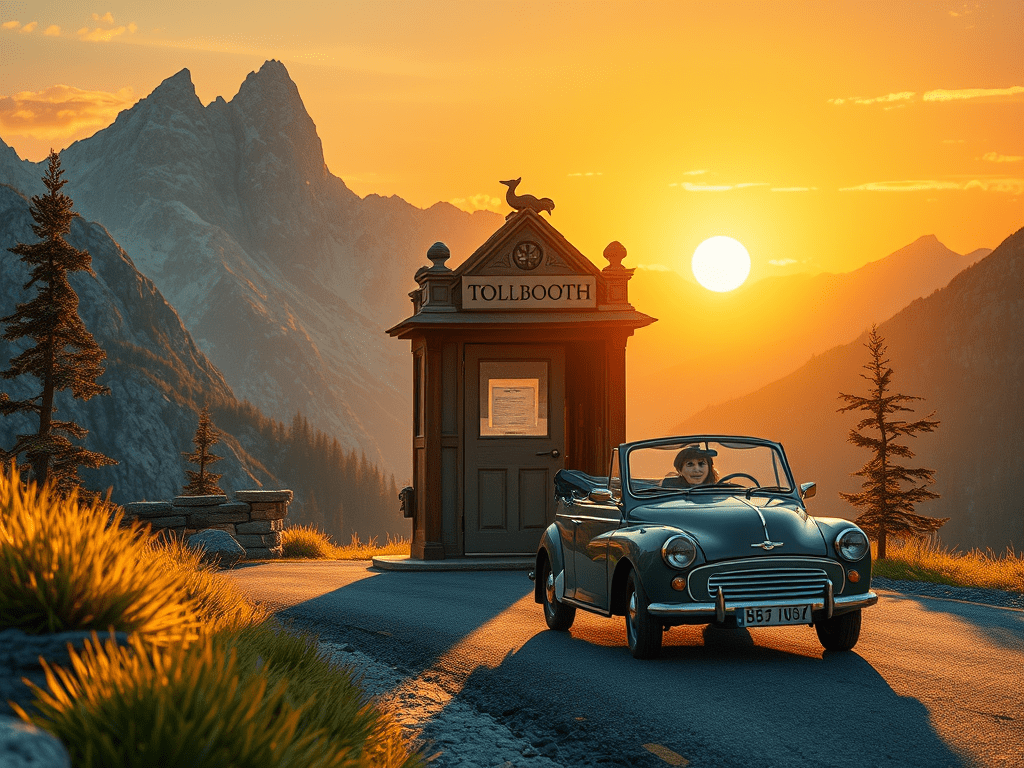
    Every now and then, I stumble across a story that feels like a wink from the universe—a tale that plays with words, dances through logic, and reminds me to laugh at life’s oddities. Whimsical fiction offers this gentle delight. It’s clever without being cynical, profound without being ponderous. At its best, it speaks to the childlike curiosity that, oddly enough, is more alive in me today than when I was a child.

    Whimsical fiction is often misjudged as mere fluff, but that couldn’t be further from the truth. These books are gateways—offering not escape from reality, but a different lens through which to view it. They play with absurdity and exaggeration to point out our very real human foibles. Through gentle humor and unexpected twists, they invite us to see familiar things in unfamiliar ways. A talking dog may teach responsibility better than a lecture. I know I’d sit up and pay attention! A world made of puns might show the value of precision.

    One timeless and brilliantly whimsical book is Norton Juster’s, “The Phantom Tollbooth”. Published in 1961, it remains a literary gem that enchants both children and adults. Its charm lies in its rich wordplay, fantastical settings, and clever commentary on education, curiosity, and the importance of words. At the center of the story is Milo, a bored, lethargic boy who is gifted a mysterious tollbooth and embarks on a magical journey to the Lands Beyond. There, he meets characters such as Tock the watchdog (who actually has a clock embedded in his body), the Whether Man (who doesn’t know whether it will rain or shine), and King Azaz, ruler of the Kingdom of Letters.

    The brilliance of “The Phantom Tollbooth” lies not just in its surreal whimsy, but in its celebration of knowledge and language. The book is a love letter to words—and a powerful reminder that the right words matter. Milo learns that choosing his words carefully can change the course of events. He discovers that vague, careless language often leads to confusion, misunderstandings, or, in the world of the book, literal chaos. In a scene where he visits the Island of Conclusions (which one can only reach by jumping), the moral is plain: people leap to conclusions far too often without thought or reasoning. Admit it, we are all guilty of this at one time or another.

    Through its delightful metaphors and wordplay, Juster creates an allegorical map of how we think, speak, and learn. Words in “The Phantom Tollbooth” aren’t just tools—they’re treasures. They’re weighed, debated, flung in arguments, and lovingly defended. The story’s central conflict—a battle between the warring kingdoms of Letters and Numbers—highlights our tendency to pit logic against imagination, structure against story. It is only through the return of the princesses, Rhyme and Reason, that harmony is restored.

    Language Matters—Now More Than Ever

    The novel’s message feels especially urgent today. In a world flooded with sound bites, scrolling feeds, and knee-jerk reactions, our use of language has become increasingly casual. Texts are abbreviated. Social media encourages speed over substance. Civil discourse gives way to mocking irreverence, sarcasm, and sensationalism. Words are often wielded like blunt instruments instead of sculpted tools.

    The Phantom Tollbooth” reminds us that words have weight. That communication isn’t just about speaking, but about meaning. A well-chosen phrase can build a bridge; a lazy one can burn it down. The book quietly suggests that to misuse language is to misuse thought—that sloppy language leads to sloppy thinking. As Milo journeys from Dictionopolis to Digitopolis and back again, he isn’t just growing up—he’s learning how to think clearly, speak intentionally, and listen meaningfully. ( Milo would have benefitted from Toastmasters International Org. )

    In today’s world, where misinformation spreads faster than spilt milk and nuance is often sacrificed for viral appeal, whimsical fiction like Juster’s becomes not just entertaining, but essential. It teaches us, without ever preaching, that language shapes how we understand the world and each other. That the right word, delivered kindly, can change a day—or a life.

    The Joy of Wordplay

    What makes whimsical fiction so refreshing is its commitment to play. It finds humor and meaning in the absurd. If it’s the characters who argue over whether “mean” has one definition or three, or a banquet where guests actually eat their words, “The Phantom Tollbooth” celebrates the strange, hilarious, and deeply human ways we use language.

    This love of play isn’t frivolous. It’s freeing. It opens the door to creativity and flexibility of thought. In a society that often prizes efficiency and productivity, whimsical fiction offers permission to pause and ponder—to explore without an agenda. It encourages us to find joy in small things: a pun, a rhyme, a cleverly turned phrase. And in doing so, it invites us to reconnect with the kind of imaginative thinking that fuels both empathy and invention.

    Other Notable Whimsical Works

    Of course, “The Phantom Tollbooth” isn’t alone in its category. Whimsical fiction has given us a rich array of characters and worlds—from the talking animals of “Charlotte’s Web” , by E. B. White, to the curious rules of “Alice in Wonderland”, by Lewis Carroll. More recently, novels like “The House in the Cerulean Sea”, by TJ Klune, and “Miss Pettigrew Lives for a Day“, by Winifred Watson, have added modern warmth and sparkle to the genre.

    These books share a common thread: they soften the edges of life’s seriousness without dulling its importance. They often center on overlooked people—lonely children, eccentric old women, oddball bureaucrats—and show how even the smallest person can bring about change. Their magic lies not in explosions or epic battles, but in kindness, insight, and surprising turns of phrase.

    Whimsy in a Grown-Up World

    Some may wonder whether whimsical fiction is just for children. The answer is a resounding NO! In fact, I believe that its relevance may grow with age. As adults, we often become entrenched in practicality and routine. The “real world” demands results, bills must be paid, the treadmill never stops. But whimsy invites us to imagine again. To find wonder in language, laughter in logic, and magic in meaning.

    As C.S. Lewis famously said, “When I became a man I put away childish things, including the fear of childishness and the desire to be very grown-up.” Whimsical fiction allows us to reclaim that fearlessness. It gives us courage to be curious, to ask silly questions, and to learn something profound in the process.

    What We Gain from Whimsical Fiction

    Whimsical stories are a reminder to be playful. Fellow Readers, life is serious enough. These stories make room for joy in our lives. They give us a deeper love of language. Words are chosen with care, which can rekindle our own appreciation for how we speak and write. They are an invitation to question – whimsy often turns logic on its head, encouraging us to think critically and creatively. Whimsical fiction is a celebration of kindness and curiosity.

    Final Thoughts: A Tollbooth of Our Own

    We may not all discover a mysterious cardboard tollbooth in our bedroom, but we can still take the journey. Every time we pick up a whimsical novel, we step into a world where the impossible becomes plausible—and where the rules of reality bend just enough to help us see things differently. “The Phantom Tollbooth” reminds us that language is not only our most practical tool, but also our most powerful one. In a time when words are so often thrown away, Juster urges us to cherish them. Use them well. Laugh at them, question them, savor them. Because in the end, words are how we express who we are, and who we want to become. So the next time life begins to wear you down, reach for something whimsical. Let it lift your spirits and sharpen your thinking. Let it remind you that meaning has always mattered – and it still matters. Let it remind you that even a bored child ( of any age ) can change the world with the right words.

    Til next time……

    Your Turn: What whimsical book has stayed with you? Do you have a favorite word or passage from “The Phantom Tollbooth“? I’d love to hear from you!

    Hi! I hope you enjoy my blog posts. I’d love to hear your comments and look forward to reading your blog if you are a blogger.

    Hi! I hope you enjoy my blog posts. I’d love to hear your comments and look forward to reading your blog if you are a blogger.

    Hi! I hope you enjoy my blog posts. I’d love to hear your comments and look forward to reading your blog if you are a blogger.

2 responses to “The Trip of a Lifetime”

  1. arbiterloudlya3dcb3c6a8 Avatar
    arbiterloudlya3dcb3c6a8

    Thank you, Juel, for that brief trip through the backroads of England over 100 years ago! It would have been an immense pleasure to take in those sights and take part in what I imagine would have been civil and engaging conversations. You have described a world that so many of us long to experience, and still can when we open the pages of a book. I wonder how many copies of “Four On A Tour In England” are still out there collecting dust?

    Liked by 1 person

    1. jslco529 Avatar

      Thank you so much for your kind comments. I’m glad you enjoyed my post and hope you’ll continue to comment on future postings.
      God Bless.

      Like

Hi! I hope you enjoy my blog posts. I’d love to hear your comments and look forward to reading your blog if you are a blogger.