Tag: Retirement

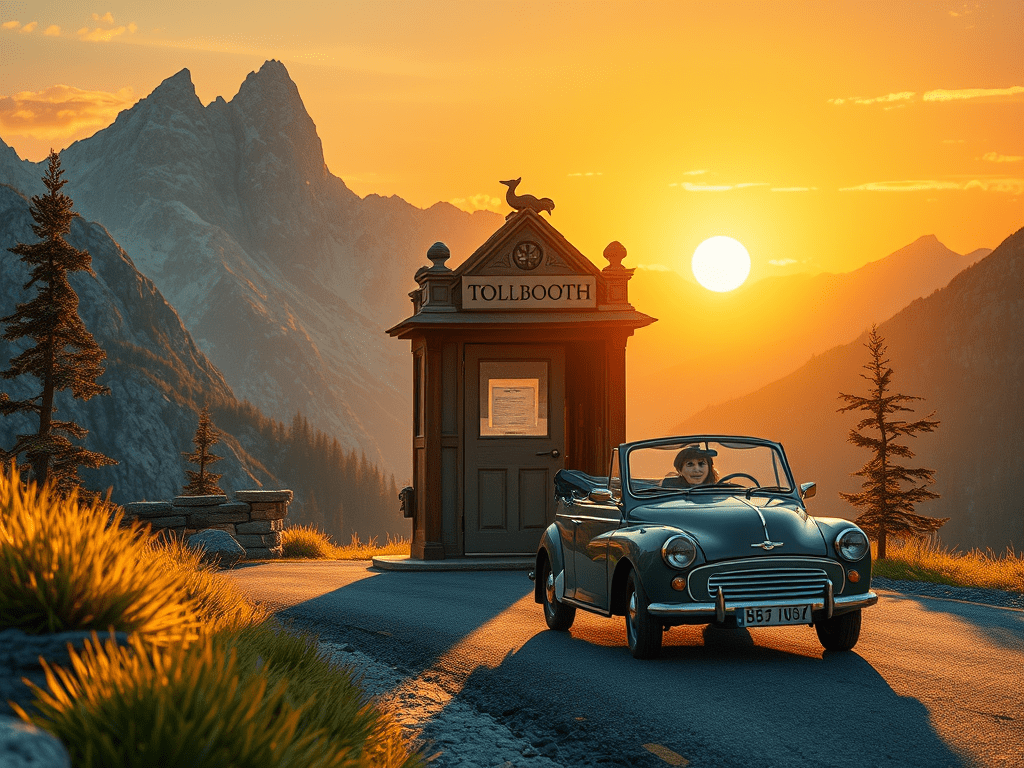
  • Through the Tollbooth and Into Retirement

    Through the Tollbooth and Into Retirement

    Fiction and the Power of Words

    Every now and then, I stumble across a story that feels like a wink from the universe—a tale that plays with words, dances through logic, and reminds me to laugh at life’s oddities. Whimsical fiction offers this gentle delight. It’s clever without being cynical, profound without being ponderous. At its best, it speaks to the childlike curiosity that, oddly enough, is more alive in me today than when I was a child.

    Whimsical fiction is often misjudged as mere fluff, but that couldn’t be further from the truth. These books are gateways—offering not escape from reality, but a different lens through which to view it. They play with absurdity and exaggeration to point out our very real human foibles. Through gentle humor and unexpected twists, they invite us to see familiar things in unfamiliar ways. A talking dog may teach responsibility better than a lecture. I know I’d sit up and pay attention! A world made of puns might show the value of precision.

    One timeless and brilliantly whimsical book is Norton Juster’s, “The Phantom Tollbooth”. Published in 1961, it remains a literary gem that enchants both children and adults. Its charm lies in its rich wordplay, fantastical settings, and clever commentary on education, curiosity, and the importance of words. At the center of the story is Milo, a bored, lethargic boy who is gifted a mysterious tollbooth and embarks on a magical journey to the Lands Beyond. There, he meets characters such as Tock the watchdog (who actually has a clock embedded in his body), the Whether Man (who doesn’t know whether it will rain or shine), and King Azaz, ruler of the Kingdom of Letters.

    The brilliance of “The Phantom Tollbooth” lies not just in its surreal whimsy, but in its celebration of knowledge and language. The book is a love letter to words—and a powerful reminder that the right words matter. Milo learns that choosing his words carefully can change the course of events. He discovers that vague, careless language often leads to confusion, misunderstandings, or, in the world of the book, literal chaos. In a scene where he visits the Island of Conclusions (which one can only reach by jumping), the moral is plain: people leap to conclusions far too often without thought or reasoning. Admit it, we are all guilty of this at one time or another.

    Through its delightful metaphors and wordplay, Juster creates an allegorical map of how we think, speak, and learn. Words in “The Phantom Tollbooth” aren’t just tools—they’re treasures. They’re weighed, debated, flung in arguments, and lovingly defended. The story’s central conflict—a battle between the warring kingdoms of Letters and Numbers—highlights our tendency to pit logic against imagination, structure against story. It is only through the return of the princesses, Rhyme and Reason, that harmony is restored.

    Language Matters—Now More Than Ever

    The novel’s message feels especially urgent today. In a world flooded with sound bites, scrolling feeds, and knee-jerk reactions, our use of language has become increasingly casual. Texts are abbreviated. Social media encourages speed over substance. Civil discourse gives way to mocking irreverence, sarcasm, and sensationalism. Words are often wielded like blunt instruments instead of sculpted tools.

    The Phantom Tollbooth” reminds us that words have weight. That communication isn’t just about speaking, but about meaning. A well-chosen phrase can build a bridge; a lazy one can burn it down. The book quietly suggests that to misuse language is to misuse thought—that sloppy language leads to sloppy thinking. As Milo journeys from Dictionopolis to Digitopolis and back again, he isn’t just growing up—he’s learning how to think clearly, speak intentionally, and listen meaningfully. ( Milo would have benefitted from Toastmasters International Org. )

    In today’s world, where misinformation spreads faster than spilt milk and nuance is often sacrificed for viral appeal, whimsical fiction like Juster’s becomes not just entertaining, but essential. It teaches us, without ever preaching, that language shapes how we understand the world and each other. That the right word, delivered kindly, can change a day—or a life.

    The Joy of Wordplay

    What makes whimsical fiction so refreshing is its commitment to play. It finds humor and meaning in the absurd. If it’s the characters who argue over whether “mean” has one definition or three, or a banquet where guests actually eat their words, “The Phantom Tollbooth” celebrates the strange, hilarious, and deeply human ways we use language.

    This love of play isn’t frivolous. It’s freeing. It opens the door to creativity and flexibility of thought. In a society that often prizes efficiency and productivity, whimsical fiction offers permission to pause and ponder—to explore without an agenda. It encourages us to find joy in small things: a pun, a rhyme, a cleverly turned phrase. And in doing so, it invites us to reconnect with the kind of imaginative thinking that fuels both empathy and invention.

    Other Notable Whimsical Works

    Of course, “The Phantom Tollbooth” isn’t alone in its category. Whimsical fiction has given us a rich array of characters and worlds—from the talking animals of “Charlotte’s Web” , by E. B. White, to the curious rules of “Alice in Wonderland”, by Lewis Carroll. More recently, novels like “The House in the Cerulean Sea”, by TJ Klune, and “Miss Pettigrew Lives for a Day“, by Winifred Watson, have added modern warmth and sparkle to the genre.

    These books share a common thread: they soften the edges of life’s seriousness without dulling its importance. They often center on overlooked people—lonely children, eccentric old women, oddball bureaucrats—and show how even the smallest person can bring about change. Their magic lies not in explosions or epic battles, but in kindness, insight, and surprising turns of phrase.

    Whimsy in a Grown-Up World

    Some may wonder whether whimsical fiction is just for children. The answer is a resounding NO! In fact, I believe that its relevance may grow with age. As adults, we often become entrenched in practicality and routine. The “real world” demands results, bills must be paid, the treadmill never stops. But whimsy invites us to imagine again. To find wonder in language, laughter in logic, and magic in meaning.

    As C.S. Lewis famously said, “When I became a man I put away childish things, including the fear of childishness and the desire to be very grown-up.” Whimsical fiction allows us to reclaim that fearlessness. It gives us courage to be curious, to ask silly questions, and to learn something profound in the process.

    What We Gain from Whimsical Fiction

    Whimsical stories are a reminder to be playful. Fellow Readers, life is serious enough. These stories make room for joy in our lives. They give us a deeper love of language. Words are chosen with care, which can rekindle our own appreciation for how we speak and write. They are an invitation to question – whimsy often turns logic on its head, encouraging us to think critically and creatively. Whimsical fiction is a celebration of kindness and curiosity.

    Final Thoughts: A Tollbooth of Our Own

    We may not all discover a mysterious cardboard tollbooth in our bedroom, but we can still take the journey. Every time we pick up a whimsical novel, we step into a world where the impossible becomes plausible—and where the rules of reality bend just enough to help us see things differently. “The Phantom Tollbooth” reminds us that language is not only our most practical tool, but also our most powerful one. In a time when words are so often thrown away, Juster urges us to cherish them. Use them well. Laugh at them, question them, savor them. Because in the end, words are how we express who we are, and who we want to become. So the next time life begins to wear you down, reach for something whimsical. Let it lift your spirits and sharpen your thinking. Let it remind you that meaning has always mattered – and it still matters. Let it remind you that even a bored child ( of any age ) can change the world with the right words.

    Til next time……

    Your Turn: What whimsical book has stayed with you? Do you have a favorite word or passage from “The Phantom Tollbooth“? I’d love to hear from you!

    Hi! I hope you enjoy my blog posts. I’d love to hear your comments and look forward to reading your blog if you are a blogger.

    Hi! I hope you enjoy my blog posts. I’d love to hear your comments and look forward to reading your blog if you are a blogger.

    Hi! I hope you enjoy my blog posts. I’d love to hear your comments and look forward to reading your blog if you are a blogger.

  • “Shelf Indulgence: Reading Through Retirement”

    “Shelf Indulgence: Reading Through Retirement”

    Written by 

    jslco529

    in

    Books, Hobby, Reading, Retirement

    For years, my books waited patiently.

    They sat quietly on my shelves, their spines faded from sunlight and time, their stories unopened, their characters paused mid-sentence. In the chaos of calendars, deadlines, and early morning alarms, I would run my fingers across their covers and sigh. They were like an old friend I meant to call but never did. I promised I’d come back to them—when our son was grown, when the job slowed down, when the time was right. Someday.

    And now, someday is here.

    My retirement hasn’t been about stopping—it’s been about returning. Returning to what has always brought me comfort, joy, and wonder. The written word. The worn pages. The thrill of a new author or the comfort of an old favorite. I’m not just reading —I’m reconnecting with a lifelong love that once had to wait in the wings.

    Each morning I thank God for allowing me to wake to the new day. I read and reflect on the daily Spurgeon devotional, have breakfast with my husband, and then do a quick cleanup of the kitchen. After the last dish is loaded in the dishwasher, a happy realization hits me – I can relax with a second cup of tea and a book. No commute, no meetings, zoom or otherwise, no reason to rush. Just me, my thoughts, and books waiting to be read.

    This blog is my little corner, my book nook. A place where I’ll share what I’m reading, what I’m learning, and what I’m feeling as I settle into this next chapter of life with a book in my hand and gratitude in my heart.

    Because retirement is not the end of the story. It’s a beginning—and what a beautiful beginning it is.

    A Simple Pleasure

    One of the unexpected joys of the unfolding week is deciding which day will be spent at my favorite independent bookstore. Tucked inside a timeworn building with creaky floors and narrow aisles with shelves that groan under the weight of forgotten treasures, this bookstore is a sanctuary for old souls and older books—classics with cracked spines, curious titles from obscure authors, and volumes once loved and passed on, each one whispering a story beyond its pages. Books are my addiction. My credit card statement tells the tale. And to me they are worth every penny. Selecting the right book is a delightful, unhurried ritual. I no longer reach for what I “must” read. No need to concern myself with what is the latest flavor of the month. I reach for what draws me in—what catches my eye and piques my interest. 

    But that doesn’t always make the decision easy. In fact, it’s sometimes wonderfully overwhelming. So many tantalizing titles call out to me. Some I ignore; others I’ll take home and make my friend.


    Hardcover or Paperback?

    There is a deep, quiet satisfaction in holding a leather-bound hardcover whose once crisp pages now carry the color and warmth of age, and whose faded inscription—written to someone long ago—makes you feel as though the book itself has lived a life, loved once, and waited patiently to be held again. It’s a reassuring feeling—as though the book is saying, “I am here to stay”. Hardcovers are my first choice and they line my shelves. Each time I pull one down I’m anticipating a pleasant hour or two settled in my favorite chair with a cup of brewed Earl Grey tea sitting on the table next to me. But, you may ask, what about paperbacks? I do have some paperbacks nestled in between the weightier hardcovers. Lightweight and flexible, paperbacks are my choice for air travel or a solitary day at the local park. They definitely go with me whenever I have waiting to do. Unfortunately, doctor and dentist offices no longer have an assortment of magazines to peruse. If anything is provided to take your mind off of what is to come, it’s a loud tv set fastened on the wall with news that does anything BUT put you at ease.

    Hardcover or paperback. Either way, I’ve come to appreciate the feel of a book as part of the reading experience. It’s not only about the story—it’s about how the book feels in my hands, how it rests in my lap, how it will look sitting in between the others that have already found their place on my bookshelves and into my heart. 

    Fiction or Non-Fiction?

    I actually have the time now to discover what stories I want to invite into my life. I don’t need to impress anyone with my choices. What others think of me or my choices doesn’t matter as it once did and for this I am very thankful.

    Fiction has always been my first love. I enjoy stories that transport me—novels that unfold in faraway lands, historical fiction that brings the past to life, mysteries that keep me guessing, and literary tales that explore the depths of human nature. Reading fiction is like traveling without packing a suitcase. I’ve stood in rain-slicked alleys of Victorian London, (Anne Perry),walked through sunlit vineyards in Tuscany,(E.M.Forster), and faced injustice in small Southern towns,(Harper Lee)—all without leaving my chair.

    Non-fiction, meanwhile, feeds my curiosity. Curiosity about the past, the present, or the possibilities of the future. Retirement has pushed open the door to learning for pleasure, not obligation. I’ve read memoirs that have moved me, histories that amazed me, and essays that made me think. I love those subtle “aha!” moments.

    Biographies and autobiographies are a favorite—especially of people who have overcome incredible obstacles or who have helped change the world while working quietly behind the scenes. I love discovering the overlooked heroines of history, the ordinary and the extraordinary people who have come and gone.  People I wish I could have known. Books have offered quiet encouragement, nudging me toward adventures I might never have attempted otherwise.  It was a book, “Stick And Rudder”, by Wolfgang Langewiesche, that encouraged my interest in airplanes and flying—and soon I was in the cockpit.


    The Dance of Nostalgia and Novelty

    Every time I walk into a good independent bookstore or browse my own shelves, I feel the pull of two great loves: the books I’ve already loved and the ones I haven’t met yet.

    There’s nothing quite like rereading a book I first read decades ago. The story stays the same, but I’ve changed, therefore my thoughts about the book have changed. For example, “Ragtime”, by E.L.Doctorow, that I devoured at twenty -seven feels entirely different fifty years later. Characters I once admired now frustrate me. Others who seemed silly now evoke compassion. Sometimes I even find old notes in the margins of books I bought years ago. It’s like finding a letter from my past self to the reader I’ve become.

    Revisiting beloved books is like opening a photo album. I remember who I was when I first read “Heidi”. I was a shy seven year old who would rather be inside reading than outside playing. I can remember the emotions that books stirred in me. Joy, sadness, a longing for something different, and in one particular instance, fear. The school library book ,“Let’s Cook”, which I took out in the third grade as part of an assignment and lost the day before it was due, resulted in sleepless nights and an upset stomach. I dreaded facing the school librarian and telling her that I couldn’t find it. She held all authority over the place I loved the most – the library. I wasn’t banned but I was given a very stern lecture about responsibility. That little book resurfaced over 10 years later. We had moved to a new home in the country and my mother assigned me a few boxes to unpack. What total amazement I felt when I pulled ” Let’s Cook” out of a box marked “miscellaneous”. Time took its toll. The school and the school librarian have been gone for many years. The book is still on my shelf tucked in between others collected over the years.

    Rereading is a gift that I savor. The second or third time around I read slower, underline more, and sometimes new meanings are revealed. But there’s also the discovery of the new. A new release from a favorite author. A debut novel that gets rave reviews. A nonfiction gem I stumble upon at a library sale. These are the books that invite me into unknown territory. There’s excitement in the new—a sense of adventure.

    I have learned to follow my instincts. Every now and then I abandon a book halfway through if it doesn’t make me want to turn the page. Retirement may free up time, but I refuse to waste it on what doesn’t interest me. Some books are better left as strangers. Others I can’t wait to begin. As I write this, I have three books that I am reading depending on my mood. 


    No Pressure

    I retired from the world of finance and accounting, which required a lot of reading for the purpose of keeping up to date and informed. It was a necessity. Now I read what and when I want to and not because I have to.  Some days I read for hours. Other days, just a few pages. And that’s okay. Reading has become an act of pleasure, not performance.

    I keep a reading journal now—just a few notes with the basics: author, publisher, date, type, my reactions & comments. Not for anyone’s review, but for remembrance. The books I read become part of my life story.


    Conclusion: This Chapter Is Mine

    To sum it all up, reading for me isn’t just a hobby. Now that my joints often prefer a comfy chair over a strenuous adventure, books graciously step in. They whisk me away in time machines, teach me new skills, and open doors to worlds I never knew. And best of all, they do it all without me ever having to leave my cozy reading nook. 

    If you’ve recently retired or are dreaming of the day, I hope you rediscover, or maybe discover for the first time, the joy of reading—not just as a pastime, but as a companion, a teacher, a mirror, and a friend. Til next time……


    💬 Your Turn

    What part do books play in your life? I’d love to hear about what you’re reading.


    Hi! I hope you enjoy my blog posts. I’d love to hear your comments and look forward to reading your blog if you are a blogger.

    Hi! I hope you enjoy my blog posts. I’d love to hear your comments and look forward to reading your blog if you are a blogger.

    Hi! I hope you enjoy my blog posts. I’d love to hear your comments and look forward to reading your blog if you are a blogger.

Hi! I hope you enjoy my blog posts. I’d love to hear your comments and look forward to reading your blog if you are a blogger.